What it was
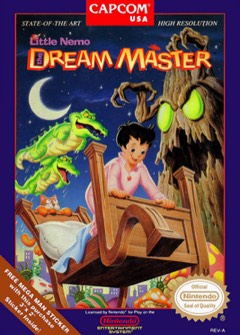
Nemo is a young boy who falls asleep and goes to Slumberland. Morpheus, its king, has been taken by the Nightmare King, and Nemo has to cross the dream to Nightmare land to get him back.
Each level is a large side-scrolling space, wider and taller than it first looks, and it is locked. Keys are scattered through it, and you find out how many you needed only when you reach the door and count the locks. Feed candy to an animal, though, and you can climb on and use what it can do: a frog, a gorilla, a mole and others, each with its own skills and its own weak points. Some levels need a particular animal. Others are just easier with one. Enemies keep coming, so moving with purpose matters.
Where it sits in history
Capcom developed and published it for the NES. It came out in the United States in September 1990, in Japan on the Famicom on 7 December 1990, and in Europe, published by Nintendo, at the end of 1991. It is based on the 1989 animated film Little Nemo: Adventures in Slumberland, itself drawn from Winsor McCay's Little Nemo in Slumberland comic strip. Junko Tamiya wrote the music, credited in the game as Gonzou.
Reviews at the time were warm. Electronic Gaming Monthly's panel compared it to Rescue Rangers in a dream and praised its pastel look and nonstop challenge; Mean Machines liked the cartoon art and the riding, but not the flicker or the instant deaths. Later writers were more divided. IGN placed it 68th of its top 100 NES games in 2009 and warned that it was hard. Hardcore Gaming 101 found the key hunts annoying. Anime News Network's Todd Ciolek liked how the animals turn each stage into a puzzle. Kirby's Adventure, three years later, would build a whole game on borrowing powers.
How it plays today
It still looks like a picture book, soft colours and odd shapes, and the music has the drifting feel of something half remembered. The animals are the joy of it. Each one is a tool and a trade-off, and working out which to bring through a room is the real game.
The difficulty is real. The not-knowing about keys can send you back through a whole level, and the late stages ask a lot. Go in patient, and treat it as a puzzle with a jump button rather than a dash to the right.
Compared with
- Kirby's Adventure: Takes the idea of borrowing a creature's power and makes it the whole game, gentler.
- Chip 'n Dale: Rescue Rangers: Capcom's other licensed NES platformer of the period, much easier.
- DuckTales: Capcom's licensed platformer where exploring is the point, at a kinder difficulty.
Why it matters
A dream is the one place every person has been that nobody else can follow. Little Nemo makes one walkable: a frog to ride, a door that wants more keys than you have, rules that make sense only while you are inside them.
Winnicott saw play as the space between the inner world and the outer one, where people get to be creative and find themselves. A game built from a sleeping child's dream sits right in that space. You step into somebody's private night, and for a while the strange logic is yours too.
Read: The magic circle: the world that rules make →
- Winnicott, D. W. (1971). Playing and Reality.
What you're levelling up
You have been training these without noticing. Here is how to do it on purpose, and where it pays off away from the couch. All the skills games teach →
Problem solving
In the game. Each animal Nemo rides, a frog, a gorilla, a mole, is a tool and a trade-off. Working out which to bring through a room is the real game.
Do it on purpose. In the next level, stop at each new section and ask which animal fits before you jump in. Check if you were right.
Off the couch. Choosing the right tool or the right person for a job is most of getting things done at work.
Spatial thinking
In the game. Levels are wider and taller than they look, with keys scattered all through them. You only find out how many you needed at the door.
Do it on purpose. Sketch a level map on paper as you go and mark every key. See if you can get to the door without doubling back.
Off the couch. Holding a map in your head helps in a new city, a new job, or a new uni campus. People follow the one who knows the way.
Bouncing back
In the game. Miss a key and you can be sent back through a whole level. The late stages ask a lot.
Do it on purpose. When you get sent back, count it as a scouting run. Note one thing you'll grab on the way through.
Off the couch. Getting knocked back and going again with a plan is what confidence actually looks like. People find that a lot more attractive than never failing.
Verdict · 8/10
One of the prettiest and strangest things on the NES, and one of the hardest of its kind. Bring candy and patience.