What it was
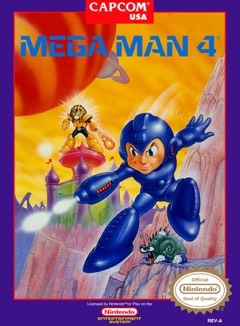
A Russian scientist, Dr. Cossack, sends eight Robot Masters to seize eight cities, and Dr. Light sends Mega Man. You pick the stages in any order, beat each boss and take its weapon: Toad Man, Bright Man, Pharaoh Man, Ring Man, Dust Man, Skull Man, Dive Man and Drill Man. The plot then turns, and the last stretch is two fortresses back to back, Cossack's and then a familiar one.
The big change is the New Mega Buster. Hold the fire button and your plain shot charges into a heavy blast. The slide from Mega Man 3 stays, Rush the dog returns as a spring, a jet and a submarine, and two hidden adaptors, the Wire and the Balloon, wait to be found in the stages. A new helper, Eddie, turns up at set points and hands over a random item.
Where it sits in history
Capcom released it on the Famicom on 6 December 1991, in North America the next month, and Nintendo published it in Europe in 1993. Keiji Inafune designed Dr. Cossack and his daughter Kalinka; Kalinka came about because the series already had so many male characters. Minae Fujii wrote the music, and it was the first Mega Man for designer Hayato Kaji, who came up with the charge shot. Inafune said the team knew a charged shot would change the whole flavour of the game, and were mindful of it.
The bosses came from a design contest for fans in Japan. More than 70,000 entries arrived; the team narrowed them to eight and changed almost nothing in the winning drawings. They liked Skull Man so much they scrapped a level in progress to rebuild it for him. Each winner received a golden cartridge, and only eight exist.
How it plays today
Mega Man still controls beautifully: tight jumps, clean hitboxes, stages built to teach you their tricks. The fan-made bosses are a fun mixed bag, and two fortresses at the end make it a longer game than the first three.
The charge shot is the argument. It is satisfying, and it makes a lot of the stolen weapons unnecessary, which blunts what made the series special. Critics at the time liked it but saw little new; later ones called it the point where the series began to slip. Both are fair. Taken on its own terms it is a very good NES action game, just not Mega Man 2 or 3.
Compared with
- Mega Man 3: The year before, with the slide and Rush already in place, and a stronger set of bosses.
- Mega Man 2: The one most people hold up as the best; no charge shot, so every weapon matters.
- Mega Man 5: The next year's sequel, which keeps the charge shot and the two-fortress ending.
Why it matters
Inafune said Eddie was meant to behave like a lottery: sometimes his gift delights you, sometimes it lets you down. That is reward prediction error in a robot with a lid on his head. Wolfram Schultz and his colleagues found that dopamine neurons signal the gap between what we expected and what we got, not the reward itself. Eddie lives in that gap, which is why players remember him.
The bosses carry another lesson. Seventy thousand people drew a robot, and eight of them became part of a game. Donald Winnicott described play as the space between our inner world and the outer one, where people make things and find themselves. A child's drawing of Skull Man crossing into a cartridge is about as literal as that gets.
Read: Wanting, not liking: what dopamine really does when you play →
- Schultz, W., Dayan, P., & Montague, P. R. (1997). A neural substrate of prediction and reward. Science, 275(5306), 1593-1599. doi:10.1126/science.275.5306.1593
- Winnicott, D. W. (1971). Playing and Reality.
What you're levelling up
You have been training these without noticing. Here is how to do it on purpose, and where it pays off away from the couch. All the skills games teach →
Timing and rhythm
In the game. The New Mega Buster charges when you hold fire. Let go too early and it's a pea shot; too late and you've been hit.
Do it on purpose. Fight one Robot Master using only charged shots. Learn the gap in its pattern where a full charge fits.
Off the couch. Timing is everything when you ask for a raise or bring up a hard topic. Wait for the opening, then go.
Curiosity
In the game. The Wire and the Balloon adaptors are hidden in the stages. You only get them by looking.
Do it on purpose. Before you finish any stage, check one spot you'd normally skip. Note how many extras you turn up.
Off the couch. Looking a bit harder turns up the better deal, the better job, the better story. Curious people are rarely bored.
Pattern recognition
In the game. Stages are built to teach you their tricks, and every Robot Master from Toad Man to Drill Man has a learnable rhythm.
Do it on purpose. Die on a boss, then describe in one sentence what killed you before you hit continue.
Off the couch. Naming the pattern after a bad week at work or a fight with a mate is how you stop repeating it.
Verdict · 7/10
A polished entry that added the charge shot the series kept for good, and lost a little of its puzzle in doing so. Play it after Mega Man 2 and 3, not instead of them.