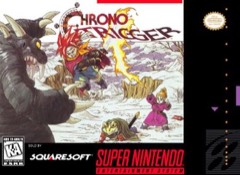
What it was
It opens at a fair. Crono meets Marle, his inventor friend Lucca shows off a teleporter, Marle's pendant reacts badly, and she vanishes 400 years into the past. From there the party hops between prehistory, the Middle Ages, a floating magic kingdom, a ruined future and the End of Time, a hub outside history, chasing a creature called Lavos that will wreck the world in 1999.
Battles happen right where you meet enemies, with no cut to a separate screen, and many monsters are in plain sight before you touch them. Each character learns eight Techs, and pairs or trios with the right ones combine them into Double and Triple Techs, so who you bring changes how every fight plays. Seven eras feed into one another: fix something in the past and the future shifts.
Where it sits in history
Square billed its core creators as a Dream Team: Hironobu Sakaguchi of Final Fantasy, Yuji Horii of Enix's Dragon Quest, and Dragon Ball artist Akira Toriyama. Masato Kato wrote most of the story, Kazuhiko Aoki produced, and Yasunori Mitsuda scored it with help from Nobuo Uematsu. It was planned for Nintendo's Super Famicom disk drive; when that was cancelled it moved to a 32-megabit cartridge with battery saves.
It came out in Japan in March 1995 and North America that August, selling two million copies in Japan in two months, second that year only to Dragon Quest VI. It also introduced New Game Plus, letting you restart with your levels and gear, and its multiple endings depend on when you choose to face Lavos, which you can do early. The DS version brought it to PAL regions in 2009.
How it plays today
Beautifully. It is brisk by the standards of its genre, rarely sends you on errands, and the combo system keeps even ordinary fights interesting. Toriyama's characters are expressive and funny, Frog's and Magus's stories still land, and Mitsuda's music is among the best on the console. The End of Time hub gives gentle hints so you are seldom lost.
The flaws are small. It is on the easy side, especially compared with Final Fantasy VI, and the main story ends sooner than you might want, though side quests and New Game Plus stretch it well. Crono never speaks, which some players find flat. The PC version launched in rough shape in 2018 but was patched heavily and now offers the original graphics.
Compared with
- Final Fantasy VI: Square's other SNES giant is bigger and darker; Chrono Trigger is lighter on its feet and faster to finish.
- Dragon Quest VI: Maboroshi no Daichi: Horii's own series, also with Toriyama art; the only game to outsell Chrono Trigger in Japan in 1995.
- Star Ocean: Another late Super Famicom RPG built on real-time combat and many endings, from a different house.
Why it matters
Chrono Trigger is a game about going back. Fix something in the past and the future shifts; a ruined world can be mended by a visit to an older one. It is hard to think of a better picture of what people do with memory, and with this game in particular. Plenty of adults first played it as kids and still hum Mitsuda's music without meaning to.
Tim Wildschut and colleagues found nostalgia is mostly positive, often features close others, and raises social connectedness and self-regard. That fits. What people remember about Chrono Trigger is rarely the menus. It is Frog's story, the fair at the start, and who sat beside them on the floor. New Game Plus lets you start again carrying everything you earned, and nostalgia works much the same way: you go back not to stay, but to bring something forward.
Read: Why old games feel like home →
- Wildschut, T., Sedikides, C., Arndt, J., & Routledge, C. (2006). Nostalgia: Content, triggers, functions. Journal of Personality and Social Psychology, 91(5), 975-993. doi:10.1037/0022-3514.91.5.975
What you're levelling up
You have been training these without noticing. Here is how to do it on purpose, and where it pays off away from the couch. All the skills games teach →
Systems thinking
In the game. Seven eras feed into each other: fix something in the past and the future shifts. Who you bring changes the Double and Triple Techs you get.
Do it on purpose. Try a party you've never used and note which Techs open up. Pick one fight and plan your combos before it starts.
Off the couch. What you do now shows up later, in your bank balance, your fitness and your mates. Seeing the knock-on is what lets you choose well.
Story sense
In the game. Frog's and Magus's stories still land, and the characters are expressive and funny. Read every line.
Do it on purpose. When a character does something you hate, work out why before moving on.
Off the couch. Seeing it from your partner's side is the difference between an argument and a conversation. Same with your boss or your mates.
Curiosity
In the game. Side quests and New Game Plus stretch it well past the main story. The End of Time hub hints, but there's heaps more if you poke around.
Do it on purpose. Before the final fight, chase one side quest you skipped. See what it adds.
Off the couch. Curious people are interesting people. Ask about the thing someone loves, then ask the next question.
Verdict · 10/10
Among the best role-playing games of the 16-bit era, and one of the easiest to recommend to someone new to the genre. Few games this old feel so light and so complete.