What it was
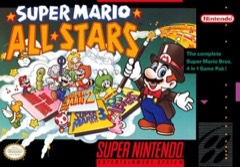
One cartridge, four games: Super Mario Bros., The Lost Levels, Super Mario Bros. 2 and Super Mario Bros. 3, each redrawn and rescored for the Super NES. The levels, the secrets and the way Mario moves are the same; what changed is everything around them. Backgrounds gained parallax layers, Mario got a black outline to stand out, dark castle rooms gained portraits of Bowser and Mario, and the music gained echo and bass.
The quieter changes matter more. Every game saves, with four files each, so you can pick up from the start of any world you have reached. You start with more lives. Glitches that could trip you up were fixed and the Minus World is gone, while a few helpful ones stayed. The Lost Levels saves after every level, hands out more 1-ups and checkpoints, and its poison mushrooms are easier to tell apart. Super Mario Bros. 3 even keeps a two-player Mario Bros. bonus game tucked inside.
Where it sits in history
Nintendo EAD made it after Super Mario Kart, to fill a gap while Yoshi's Island was still in production. Shigeru Miyamoto suggested a value pack, partly to let players finally try The Lost Levels, which Nintendo had judged too hard for North America back in the NES days. Rather than copy the NES games across, the team remade them by hand, with Tadashi Sugiyama running the original Super Mario Bros. beside the remake to compare. Naoki Mori, in his third year at Nintendo, felt the weight of updating the flagship series, and avoided debugging The Lost Levels because it was so hard.
It came out in Japan, as Super Mario Collection, on 14 July 1993, in North America in August and in Europe on 16 December. It became the Super NES pack-in, topped the UK charts in September 1993, and sold 10.55 million copies by 2015. A 1994 edition added Super Mario World. In 1997 Electronic Gaming Monthly said that if compilations were allowed on its Top 100, All-Stars would be the clear number one; Famitsu later called it a role model for remakes.
How it plays today
This is still the friendliest way into the NES Mario games. Saving changes everything: you can chip away at Super Mario Bros. 3 over a week instead of in one sitting, and The Lost Levels becomes something you can actually finish rather than a wall. The 16-bit art is warm and cartoonish, and the music is a treat.
Purists have a point. The physics were nudged, and some players feel the controls are a touch less instinctive than the originals. Critics at the time also noted there was nothing new beyond the polish. But as a package it is hard to beat: the whole start of the series on one cartridge, made by people who clearly loved it.
Compared with
- Super Mario Bros. 3: The NES original of the collection's best game, for those who want it exactly as it was.
- Super Mario World: The art style All-Stars borrowed, and the game added to it in the 1994 edition.
- Super Mario Bros. 2: The odd one out in the collection, and one EGM reviewer's pick of the four.
Why it matters
The team changed the paint and left the feel alone on purpose. Sugiyama played the old game beside the new one so nothing would drift. They understood that what people loved was not the pixels but the jump, and the memory of where the secret vine was.
Wildschut and colleagues found nostalgia is mostly a warm feeling, often full of other people, and that it raises a sense of connection. All-Stars gave that feeling a new coat and handed it to a new generation. Parents could show their kids the warp zone they found in 1985, on the console the kids already owned.
Read: Why old games feel like home →
- Wildschut, T., Sedikides, C., Arndt, J., & Routledge, C. (2006). Nostalgia: Content, triggers, functions. Journal of Personality and Social Psychology, 91(5), 975-993. doi:10.1037/0022-3514.91.5.975
What you're levelling up
You have been training these without noticing. Here is how to do it on purpose, and where it pays off away from the couch. All the skills games teach →
Bouncing back
In the game. Every game saves, with four files each, so The Lost Levels becomes something you can actually finish rather than a wall.
Do it on purpose. Pick the Lost Levels world that's beating you. Play only that one until you clear it.
Off the couch. Chipping away at something hard over a week, a uni assignment or a fitness goal, works better than one big heroic go.
Curiosity
In the game. Pipes hide bonus rooms, warp zones skip whole worlds, and Super Mario Bros. 3 even has a two-player Mario Bros. game tucked inside.
Do it on purpose. Replay a world you've cleared and only hunt for secrets. Count how many you find.
Off the couch. Poking around, a new suburb, a new hobby, asking someone what they're into, is where the good stuff is found.
Winning and losing well
In the game. Four classics and a second player taking turns as Luigi. Someone's going to fall in a pit and someone's going to laugh.
Do it on purpose. Play Super Mario Bros. 3 two-player with a mate and swap the pad on every death, no complaining.
Off the couch. Being easy company on a games night, with mates or on a date, matters more than being good. Laugh at the pits.
Verdict · 9/10
The kindest way to play early Mario, and the remake other remakes were measured against. Start a save file and go.