What it was
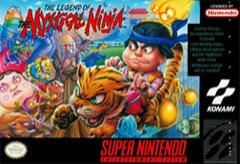
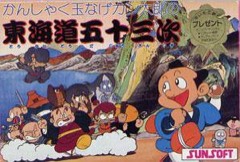
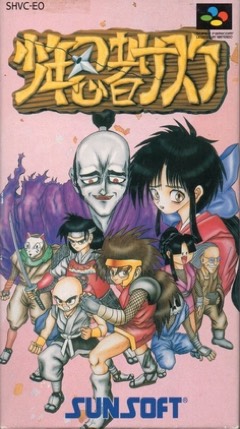
An action-adventure for one or two players. Goemon and his friend Ebisumaru, renamed Kid Ying and Dr. Yang in English, look into ghosts at their local temple in Oedo and end up crossing old Japan to rescue Princess Yuki. On the way they meet a ninja cat, a festival of suspicious dancers, an army of mimes and clowns with an anachronistic amusement park, and a palace of clockwork ninjas. A wise man fires them across the country from a cannon he calls a Miracle Transport Machine.
Each stage has two halves. First a town, where you talk to people, shop, learn special moves and spend your money on games: air hockey, trivia, dice, a lottery, and the first level of Gradius. Then an action stage to fight through to a boss. With two players, one can ride piggy-back on the other: the rider attacks, the one underneath runs and jumps, so only one of you has to make the hard jumps.
Where it sits in history
Konami released it on the Super Famicom on 19 July 1991 and in North America in 1992. It was the fifth main Ganbare Goemon game and the first to leave Japan. At home it was a hit, selling over 521,000 copies, and three Super Famicom sequels followed. Electronic Gaming Monthly said it never really caught on in the United States.
Critics liked it. It appears in 1001 Video Games You Must Play Before You Die, and Total! called it a right bloody good laugh. It returned on the Wii Virtual Console in 2007, on the Japanese Super Famicom Mini in 2017, and in the 2026 compilation Ganbare Goemon! Daishūgō.
How it plays today
Almost nothing else plays quite like it. The towns are the treat: you poke into every shop and inn, gamble your coins, and find out what odd thing this one is hiding. The action stages are solid rather than special, but the variety keeps you moving, and the music and colour are as good as anything on the console.
A few towns drag. Play it with a friend if you can. The piggy-back trick is silly and genuinely useful, and arguing over whether to spend the money on armour or another round of the lottery is half the fun.
Compared with
Why it matters
Caillois placed play on a line running from paidia, free and silly play, to ludus, play with firm rules. Most games pick a spot on that line. Mystical Ninja swings back and forth on purpose: the towns are paidia, full of gambling and nonsense and doors you open just to see, and the stages are ludus, with a route, a boss and a clear way to win.
That rhythm is why people remember it so fondly. You earn your play time in the stage and spend it in the town, and both halves make the other better. It is a holiday with chores in between, which is a fair description of a good weekend.
Read: The magic circle: the world that rules make →
- Caillois, R. (1958/1961). Man, Play and Games (trans. M. Barash).
What you're levelling up
You have been training these without noticing. Here is how to do it on purpose, and where it pays off away from the couch. All the skills games teach →
Teamwork
In the game. With two players, one rides piggy-back: the rider attacks and the one underneath runs and jumps, so only one of you has to nail the hard jumps.
Do it on purpose. Put the better jumper underneath for a stage, then swap. Talk through every hard jump before you take it.
Off the couch. Knowing who's better at what and letting them do it, no ego, is how good couples and good teams run.
Curiosity
In the game. The towns are the treat. Every shop and inn hides something odd, and there's even the first level of Gradius tucked in there.
Do it on purpose. In the next town, talk to everyone and walk into every door before leaving. Note one thing you'd have missed.
Off the couch. Whoever wanders down the side street finds the good bar. Curiosity makes every holiday, job and friendship bigger.
Judging risk
In the game. Your coins go on armour or another round of the lottery, dice or trivia. Arguing over it is half the fun.
Do it on purpose. Set a rule before each town: half the coins on gear, the rest on games. See whether you get further than when you blow the lot.
Off the couch. A fun budget is still a budget. Knowing what you can afford to lose on a punt keeps the fun from eating your rent.
Verdict · 8/10
A generous, silly, beautiful journey that mixes a town crawl with a brawler and throws in a free Gradius level. Best with two.