What it was
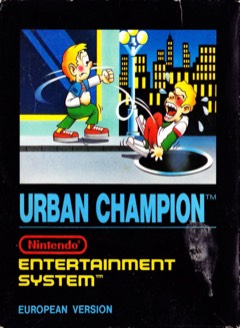
Two men square up on a city footpath. Each raises or lowers his guard, and you land a punch by hitting high when the other man guards low, or low when he guards high. A quick jab costs little and is hard to stop; a heavy punch does more damage but is slow enough to block or dodge. Every punch you throw spends one of your 200 stamina points, and once you run out, every hit knocks you back like a heavy punch.
Push the other man off the edge of the screen and the fight moves down the block for the next round. Best of five wins. Lose two rounds and an open manhole appears behind you; get shoved into it and it's over. A man drops flowerpots from the windows, a passing police car sends both fighters back to the middle, and if the 99-second clock runs out the police arrest whoever is nearest the edge. In the one-player game you need 45 wins in a row to be called Champion.
Where it sits in history
Nintendo made it, taking its idea from Boxing, a 1984 Game & Watch. It came out on the Famicom in Japan on 14 November 1984 and on the NES in North America and Europe in 1986. There was an arcade version too, Vs. Urban Champion. It was Nintendo's first fighting game; the next came in 1993 with the Famicom's Joy Mech Fight.
Reviews were poor then and worse later. Nintendo Power's 1990 guide to every NES game gave it 1.5 out of 5 in two categories; only Chubby Cherub also fell below 2 anywhere. Later critics at GameSpot, IGN and 1UP called it tedious, shallow, and one of the weakest games on the Virtual Console. Hamster put the arcade version on Switch in its Arcade Archives line in November 2018, and the NES game reached Nintendo Classics on 4 July 2024.
How it plays today
Two minutes of curiosity. High and low, fast and slow, and that's the whole fighting system. Against the computer it turns into a long grind towards 45 wins with nothing new along the way.
With a second player it's briefly funny: the flowerpots, the patrol car breaking up the brawl, the loser dropping into the sewer. Then you have seen everything it has.
Compared with
Why it matters
Erving Goffman wrote that a game builds a small shared world with its own rules about what matters. Urban Champion's world is a strange one. Two men fight in the street, a patrol car rolls by, and they simply step back to the middle. Nobody is arrested for the fight; somebody is arrested for standing nearest the kerb when the clock runs out.
That is the game deciding what counts, and the two players agreeing to it. Out on a real street the brawl would be the crime. Inside the game the brawl is the point, and the only offence is losing ground. Small and clumsy as it is, Urban Champion shows how easily we step into a set of rules and treat them as the world.
Read: The second controller →
- Goffman, E. (1961). Encounters: Two Studies in the Sociology of Interaction ('Fun in Games').
What you're levelling up
You have been training these without noticing. Here is how to do it on purpose, and where it pays off away from the couch. All the skills games teach →
Reading people
In the game. High and low, that's the whole system. Hit high when he guards low and low when he guards high, which against a second player is a guessing game with a real person.
Do it on purpose. Against a mate, watch their guard for the first round and don't throw anything heavy. Name what they do after they block, then punish it.
Off the couch. Watching before you act is half of a good first date. Most people talk over the moment; whoever notices gets the second date.
Judging risk
In the game. Every punch spends one of your 200 stamina points, and once they're gone every hit knocks you back. Heavy punches hit hard but are slow enough to block.
Do it on purpose. Fight one round with only jabs and one with only heavies. Note the stamina left and who got shoved further.
Off the couch. Energy is a budget. Spend it all early in the week and you're flat for the thing that matters on Friday.
Timing and rhythm
In the game. If the 99-second clock runs out, the police arrest whoever's nearest the edge. Where you stand at the buzzer matters as much as what you threw.
Do it on purpose. In the last ten seconds of every round, stop attacking and work your way to the middle. Count the rounds it saves you.
Off the couch. Knowing when to stop pushing, in an argument, a negotiation or a big night, is good timing. Leave on a high.
Verdict · 2/10
Nintendo's first fighting game, and it shows. Worth a look as history; nobody needs to reach the 45th win.