What it was
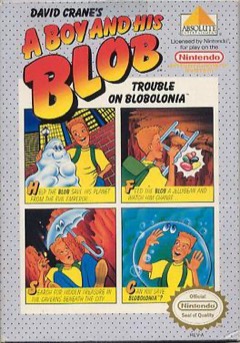
You play an unnamed boy who can run left and right. That's it. He can't jump, he can't swim, and a long fall kills him. Everything else is done by Blobert, a shapeshifting blob who follows you around under his own steam, and who turns into whatever the jelly bean in your hand says he should. Licorice makes a ladder. Apple makes a jack. Punch makes a hole, which is a pun on hole punch, and that's the point: the bean flavours are puns and alliteration so you can remember them.
The goal is to get through the caves and subways under Earth, then travel to Blobert's home planet, Blobolonia, and sort out an emperor who only lets his subjects eat sweets. Along the way you pick up treasure, swap it for vitamins at a drugstore, and use those with a VitaBlaster gun on Blobolonia. Whistle and the blob goes back to his normal shape and trots after you. The game is a string of connected screens, not a scroller.
Where it sits in history
David Crane designed and programmed it, with help from his old Activision colleague Garry Kitchen, who ran Absolute Entertainment. Crane has called the boy-and-blob idea off the wall, and said Blobert was shaped by Gloop and Gleep from the Hanna-Barbera cartoon The Herculoids. He wanted to do for adventure games what he'd done with Pitfall!, and he didn't like the usual tool inventory on screen, so the blob became the inventory.
Nintendo licensed it in the summer of 1989. A normal NES game took six to eight months. This one took six weeks, with Crane renting a room in a flophouse near the office and working sixteen to twenty hour days. Nintendo's testers played it a lot, and a senior manager treated one flaw as a bug: you could get separated from the blob and be stuck. Crane swapped the grape bean for a ketchup one that calls the blob back to you (catch up, get it?). It came out just before Christmas 1989 as Absolute's first NES game, reached Japan through Jaleco in 1990 with a younger-looking boy, and landed in Europe via Nintendo in 1991.
It won Best of Show at the 1989 Consumer Electronics Show and a Parents' Choice Award in 1990. Reviews were mixed: Mean Machines and Dragon loved the idea, and IGN reckoned the execution didn't match the idea. GamesRadar later called it a milestone for the first recognisable AI-controlled partner.
How it plays today
Be honest with yourself going in: it's slow, quiet and a bit empty, and the controls are stiff. The pleasure is the lightbulb moment, when you work out which bean solves the gap in front of you. If that sounds like your kind of afternoon, it still delivers.
Keep a pen handy. You'll want notes on what each flavour does, because you only have a few of the essential beans and wasting one can leave you stuck.
Compared with
- Adventures of Lolo: Another NES puzzler where thinking beats reflexes, but there's no sidekick doing the work.
- The Legend of Zelda: Another NES adventure built on finding the right tool for the obstacle in front of you.
Why it matters
Winnicott wrote about play as the space between the inner world and the outer one, where we get creative and find a self. A blob who becomes whatever you imagine is a neat picture of that: a friend who is half yours and half the world's.
Gee describes players taking on a projective identity, a blend of who they are and who they want the character to be. Here the boy can't do much at all, so the 'you' that solves things is the one who works with the blob.
Read: Who you are when you play →
- Winnicott, D. W. (1971). Playing and Reality.
- Gee, J. P. (2003). What Video Games Have to Teach Us About Learning and Literacy.
What you're levelling up
You have been training these without noticing. Here is how to do it on purpose, and where it pays off away from the couch. All the skills games teach →
Problem solving
In the game. A gap, a wall, a snake. You've got a pocket of jelly beans and each one turns Blobert into a different tool, so you work out which fits.
Do it on purpose. Before you feed Blobert, say out loud which bean you'll use and why. Then see if you were right.
Off the couch. Fixing a leaking tap with what's in the shed, finding a workaround when the usual plan falls over.
Teamwork
In the game. The boy can't jump or swim. Blobert does the heavy lifting, but only when you ask him the right way.
Do it on purpose. Play a whole screen asking yourself what your partner can do that you can't.
Off the couch. Handing the bit you're bad at to a mate who's good at it, on a job, a move, a group trip.
Planning ahead
In the game. You only find a limited number of the essential beans, so a wasted one can strand you.
Do it on purpose. Pick the route through a cave first and count the beans you'll need.
Off the couch. Budgeting for the month, packing for a weekend away, working out who's driving.
Verdict · 6/10
An odd, clever, slightly empty little game with an idea well ahead of its console. Play it for Blobert, not for the scenery.