What it was
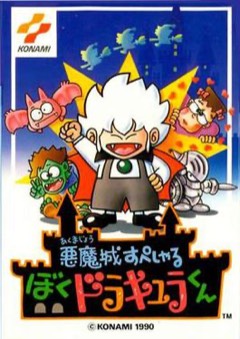
Castlevania built Konami a name for gothic horror on the Famicom: a lone hunter climbing Dracula's castle to put the old vampire back in the ground. In 1990 the company flipped the idea over. Akumajō Special: Boku Dracula-kun makes the vampire's side the heroes, and the star is a child: Kid Dracula, a self-proclaimed Demon King who has just woken from a very long sleep.
The story is a sketch, and a funny one. While Kid Dracula slept, a demon named Galamoth decided to challenge him. So the kid helps himself to his father's cape and sets off to put the upstart in his place. It is a platform game and, by general agreement, a parody of the series it springs from. The payoff is a lovely ending. Beating Galamoth makes Kid Dracula famous across the land, and every monster in Transylvania turns up at his castle hoping to be his friend.
Where it sits in history
Konami released it on the Famicom in Japan in October 1990. Famitsu scored it 25 out of 40. The music is credited to Konami Kukeiha Club, with Satoko Miyawaki and Shinji Tasaka behind the tracks. It appeared on the album Konami Famicom Music Memorial Best Vol. 3 in February 1991, and EGG Music issued a complete soundtrack in August 2014.
For a long time the game stayed in Japan. A mobile phone version appeared there on 30 June 2006. In 1993 Konami made a Game Boy follow-up, simply called Kid Dracula, which did reach English-speaking players; Retro Gamer's Faith Johnson has said it feels more like a remake than a sequel, since so many of its stages resemble the Famicom game's. The original finally arrived in English on 16 May 2019, localised as Kid Dracula, as part of the Castlevania Anniversary Collection.
How it plays today
The joke is the reason to play. Seeing Castlevania's world from the other side, through a small vampire with a very high opinion of himself, is a pleasure the serious games never offered. The ending, with the monsters of Transylvania queuing at his door to be friends, is as sweet as anything Konami made on the system.
As a platformer it sits a step below Konami's best on the Famicom. Famitsu's middling score at the time looks fair: it is tidy and likeable rather than essential, a game to enjoy over a couple of evenings rather than one to master. The Anniversary Collection is the easy way in, with an English script and none of the expense of importing a cartridge.
Compared with
Why it matters
Kid Dracula has the energy of a child in a parent's coat. The cape is Dad's, the title of Demon King is self-awarded, and the whole adventure is a small person insisting on being taken seriously by a world of monsters.
Lev Vygotsky wrote that in play a child acts a head taller than they are: play stretches people just past what they can do. Pretending to be bigger is part of how we grow. Konami built a whole game around that feeling and handed it to a vampire. The best part is where it lands. Kid Dracula beats Galamoth, and the reward is not treasure or a throne. Every monster in Transylvania turns up wanting to be friends. That is what most of us were playing for as kids too: the chance to stand a head taller for an afternoon, and someone to share it with afterwards.
Read: Older than us: play before people →
- Vygotsky, L. S. (1978). Mind in Society: The Development of Higher Psychological Processes.
What you're levelling up
You have been training these without noticing. Here is how to do it on purpose, and where it pays off away from the couch. All the skills games teach →
Picking up a language
In the game. It started as a Japanese-only Famicom game, and the original cartridge is all Japanese text. The Anniversary Collection gives you an English script, which makes a handy crib sheet.
Do it on purpose. Play a stage in English, then find the Japanese title screen and menus and match them up. Learn the kana for the words you already know.
Off the couch. A few genuine words in someone's first language is about as charming as it gets. Travel, work, new mates: it opens doors.
Story sense
In the game. It's Castlevania from the vampire's side, a kid Demon King who nicks his dad's cape. The ending, monsters queuing to be his mates, lands because you know the series it's sending up.
Do it on purpose. Before you play, think of how Castlevania frames Dracula. Spot every joke that flips it as you go.
Off the couch. Seeing it from the other side is the difference between an argument and a conversation. Works with your partner, works with your boss.
Curiosity
In the game. It's a tidy, likeable platformer built on a joke: what if the monsters were the good guys? The fun is in noticing what Konami swapped around.
Do it on purpose. Look up how Kid Dracula came to be one fact at a time between stages. There's always a story behind the parody.
Off the couch. Curious people are interesting people. Ask good questions and you're never short of something to talk about on a first date.
Verdict · 7/10
A cute, affectionate send-up of Castlevania with a warm ending. Not Konami's sharpest platformer, but an easy one to like, and now easy to play in English.