What it was
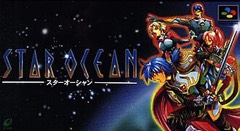
It begins as a fantasy and turns into science fiction. On a quiet planet, three friends go looking for a cure to a disease that is turning people to stone, and run into a spacefaring federation at war with another galactic power. From there the search involves starships, advanced technology and a trip through time.
Battles are random, but they play out in real time on an angled 3D-style field. You control one fighter directly and set strategies for up to three others, switching between them as you like. Outside battle, points earned in fights go into skills such as cooking and item creation, which can make better gear than any shop sells. In towns, Private Actions split the party so you can wander and find each member alone. What happens in those scenes shifts how characters feel about each other, which changes parts of the ending. Up to eight companions can join, from a pool of ten, so no single run sees everyone.
Where it sits in history
It was the first game by tri-Ace, a studio formed by staff who left Wolf Team after a troubled time making Tales of Phantasia with Namco. Enix published it in Japan on 19 July 1996. To fit the game in, the cartridge used a special S-DD1 compression chip, and the team squeezed in spoken lines during battles, a rarity on the Super Famicom. Motoi Sakuraba wrote the music.
It never reached the West on cartridge. Enix had closed its American publishing arm by the end of 1995, and Nintendo was focused on the coming Nintendo 64. English players relied on a fan translation until 2008, when Tose's PSP remake, Star Ocean: First Departure, came out in North America and Europe. It sold about 235,000 copies in Japan and started a long-running series.
How it plays today
Technically it is still startling for the hardware: detailed sprites, voice clips mid-fight and Sakuraba's progressive-rock score. The Private Actions system gives the cast more personality than most 16-bit RPGs manage, and the knowledge that you can miss characters, and shape who likes whom, makes a second playthrough appealing. The crafting systems are deep enough to lose hours in.
The battles are the sticking point. They move fast, you only control one character, and it is easy to end up mashing the attack button while the computer handles the rest. Bosses are on the weak side, feedback tri-Ace heard and answered with tougher fights in the sequel. The story leans on familiar time-travel ideas, and the Super Famicom original has no official English version, so most players will meet it through the remake.
Compared with
- Tales of Phantasia: Made by many of the same people just before they left Wolf Team; the real-time battle ideas come from there.
- Seiken Densetsu 3: Another late Japan-only Super Famicom action RPG with branching casts and replay value, with prettier art and messier fights.
- Chrono Trigger: Also mixes fantasy, science fiction and time travel; tighter and more polished, where Star Ocean is looser and more systemic.
Why it matters
Star Ocean's best idea happens away from the fighting. Walk into a town, start a Private Action, and the party scatters. You find each friend alone, and those small scenes change how the characters feel about each other and parts of the ending. Up to eight companions join from a pool of ten, so no run sees everyone. Relationships are the real progress bar.
Richard Ryan, Scott Rigby and Andrew Przybylski found games satisfy needs for competence, autonomy and relatedness, and that this predicts enjoyment and wanting to play again. Plenty of 16-bit RPGs treat the party as a row of stats. Star Ocean makes them people you check in on. Erving Goffman wrote that engrossment together is what makes an encounter feel alive, and even alone with the cartridge you are tending friendships. We play, among other reasons, to be with others, even ones made of pixels.
Read: The second controller →
- Ryan, R. M., Rigby, C. S., & Przybylski, A. (2006). The motivational pull of video games: A self-determination theory approach. Motivation and Emotion, 30(4), 344-360. doi:10.1007/s11031-006-9051-8
- Goffman, E. (1961). Encounters: Two Studies in the Sociology of Interaction ('Fun in Games').
What you're levelling up
You have been training these without noticing. Here is how to do it on purpose, and where it pays off away from the couch. All the skills games teach →
Reading people
In the game. Private Actions split the party in town so you find each member alone, and what happens shifts how they feel about each other, right through to the ending.
Do it on purpose. In every town, do the Private Actions before shopping. Pay attention to what each character wants and pick replies that fit them, not you.
Off the couch. Noticing what someone actually cares about, and responding to that, is the whole game on a date. Most people are busy talking about themselves.
Making things
In the game. Skills like cooking and item creation can make better gear than any shop sells. Points from fights go into building, not just levelling.
Do it on purpose. Put your next batch of skill points into one crafting skill and make something you'd normally buy.
Off the couch. Cooking a proper meal for mates or someone you're keen on beats any restaurant booking. Making things is a quiet kind of confidence.
Planning ahead
In the game. You control one fighter and set strategies for up to three others. Set them up badly and you end up mashing attack while the computer flounders.
Do it on purpose. Before a boss, set each ally's strategy on purpose. Afterwards, change the one who did least.
Off the couch. Setting your team up before a busy week, or your flatmates before a party, saves you doing everyone's job yourself.
Verdict · 7/10
An ambitious, technically impressive RPG that plays better as a curiosity than a classic. The remake is the practical way in; the original is for collectors and completists.