What it was
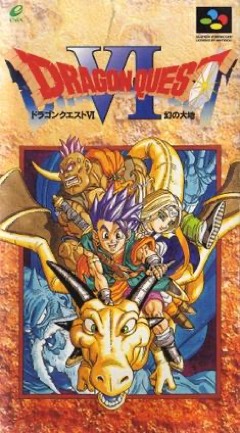
There are two worlds, and nobody in your party is sure who they are. Early on, the Hero finds that alongside the real world lies a Dream World built from people's dreams, and an evil power wants both. Crossing between them, you piece together your companions' lost memories and your own, and the discovery of how the two worlds connect drives the whole game.
Underneath is classic Dragon Quest: an overhead world, random battles fought in first person, turn-based menus and experience levels. The big system is classes. At Alltrades Abbey each character picks a starting class such as Warrior or Martial Artist; each class ranks up by winning battles, and skills learned stay with you when you switch. Master the right pairs and hybrid classes such as Gladiator open up, leading eventually to the Hero class. Around the edges sit casinos, a Slime Arena, a Best Dresser Contest, mini medals and a wagon for swapping party members.
Where it sits in history
Heartbeat developed it, taking over from Chunsoft, which had made the earlier games, and Enix published it on the Super Famicom on 9 December 1995. The series' core trio returned: Yuji Horii on scenario, Akira Toriyama on art and Koichi Sugiyama on music. It closes the trilogy of games known as the Zenithia or Zenithian trilogy. After a delay of more than a year, it went on sale at a steep price of more than 11,000 yen and sold 3.2 million copies, the best-selling game of 1995 in Japan, ahead of Chrono Trigger.
It was also the first Dragon Quest to give human characters special techniques that are not spells. An English version, reportedly planned as Dragon Warrior V, never happened: the 4MB cartridge was about as large as the console could handle, Enix had pulled out of North America, and translation would have needed even bigger, dearer chips. English speakers finally got it with the Nintendo DS remake in 2011.
How it plays today
It looks much better than Dragon Quest V, with monsters that animate when they attack, and Sugiyama's music is as warm as ever. The dual-world idea is clever, and the class system gives you real control over how your party grows. Levelling classes in the background of the main story makes long sessions feel productive, and Toriyama's cast has plenty of charm.
It is also a lot of Dragon Quest. Battles are frequent, class mastery needs many fights, and the two maps can make it hard to know where to go next. Critics have long called the class grind tedious and the twin worlds overwhelming, and both complaints are fair. The Super Famicom version was never translated, so the practical way in for most people is the DS remake.
Compared with
- Chrono Trigger: The year's other giant, also drawn by Toriyama; faster and more cinematic, but it was Dragon Quest VI that outsold it in Japan.
- Dragon Quest V: Tenkuu no Hanayome: The previous Super Famicom entry, released early in the console's life and much plainer to look at.
- Final Fantasy V: Square's own class-mixing RPG, and the closest comparison for DQVI's job system.
Why it matters
Dragon Quest VI has a class system that always wants one more fight. Win enough battles and Warrior ranks up; master the right pair and Gladiator opens; keep going and the Hero class waits at the end. Critics have long called the class grind tedious. It also sold 3.2 million copies, the best-selling game of 1995 in Japan. Both are true, and the gap between them is worth a look.
Brain imaging by Matthias Koepp and colleagues showed dopamine release in the striatum while people played a video game. Kent Berridge and Terry Robinson's work shows dopamine is more about wanting than liking. That goes a long way to explaining the Alltrades Abbey habit: you may not enjoy the next random battle much, but you badly want the rank-up it brings. Worth noticing, not worth fearing. The game wraps the wanting in dream worlds, lost memories and a Slime Arena, so at least the pull leads somewhere with a view.
Read: Wanting, not liking: what dopamine really does when you play →
- Koepp, M. J., et al. (1998). Evidence for striatal dopamine release during a video game. Nature, 393, 266-268. doi:10.1038/30498
- Berridge, K. C., & Robinson, T. E. (1998). What is the role of dopamine in reward: hedonic impact, reward learning, or incentive salience? Brain Research Reviews, 28(3), 309-369. doi:10.1016/S0165-0173(98)00019-8
What you're levelling up
You have been training these without noticing. Here is how to do it on purpose, and where it pays off away from the couch. All the skills games teach →
Systems thinking
In the game. Classes rank up by winning fights, skills stay when you switch, and the right pairs unlock hybrids like Gladiator on the road to Hero. A choice at Alltrades Abbey ripples ten hours out.
Do it on purpose. Pick one hybrid class you want, then plan each character's path to it. After the session, check whether the plan held or the grind ate it.
Off the couch. Careers stack the same way. Two skills together open doors neither opens alone, and the person who sees that picks jobs on purpose instead of drifting.
Spatial thinking
In the game. There's the real world and the Dream World, and the game makes you work out how the two maps connect. Critics reckon it's easy to lose track of where to go next.
Do it on purpose. Each session, sketch which spots in one world line up with the other. Guess where the next link is before you look anything up.
Off the couch. Finding your way back to the car after a festival at 1am, with someone you're keen on, while everyone else is on their phone. Being the one who knows the way is a quiet kind of cool.
Curiosity
In the game. Casinos, a Slime Arena, a Best Dresser Contest and mini medals tucked around both worlds. Explorers get heaps more game than people who only chase the story.
Do it on purpose. Pick one town and talk to everyone and search every pot before you leave. Count what you would have walked past.
Off the couch. Ask the new starter at work what they're into and actually listen. Curious people get invited back, and that's how you make mates as an adult.
Verdict · 7/10
A generous, classic RPG with a smart class system and a real appetite for your time. Play the DS remake unless you read Japanese.