What it was
Seven heroes, seven eras, no link you can see. A caveman, Pogo, exiled for hiding a woman meant for sacrifice. An ageing martial arts master choosing a successor. A trainee ninja, a gunslinger, a fighter chasing the title of strongest in the world, a psychic orphan at war with a biker gang, and Cube, a maintenance robot on a cargo ship with a monster loose. You pick any chapter, in any order. Each one is short, and each ends with a villain whose name carries the word Odio.
Finish all seven and an eighth opens: Oersted, a knight in the Middle Ages, then a final chapter that ties the lot together. Fights play out on a seven-by-seven grid. You step into position and pick a skill; skills cost nothing, some take turns to charge, and some leave tiles that heal or deal elemental damage. Every chapter also bends the rules. One wants stealth, one has no standard battles, one has you reading minds to find out what you need.
Where it sits in history
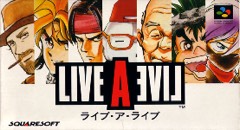
Square released it on the Super Famicom in Japan on 2 September 1994. It was Takashi Tokita's first game as director, made by the division behind Final Fantasy, and the first major RPG score from Yoko Shimomura, newly arrived from Capcom. The hook was the art: a different manga artist designed the leads of each main chapter, with Gosho Aoyama on the Edo ninja and Osamu Ishiwata on the western.
It was due out before Final Fantasy VI until delays swapped the order, and it sold 270,000 copies in Japan, a failure by Square's standards. Ted Woolsey of Square's localisation staff said its plain graphics made an overseas release unlikely, so it stayed Japanese until 2022. Virtual Console brought the original back on Wii U in 2015 and 3DS in 2016, and an HD-2D remake reached Switch worldwide in 2022, then PlayStation 4, PlayStation 5 and Windows in 2023.
How it plays today
The structure still feels fresh. Each chapter is a short story with its own trick, and you can finish one in a sitting and walk away happy. The western is a tidy little showdown, the cargo ship is a horror film in sprites, and the grid has a pleasing rhythm once you start thinking about charge times and where an enemy will stand when your move lands. Shimomura's score changes with every era and is worth the trip on its own.
Depth is what it lacks. Fights rarely push back, so the grid's best ideas never get a real workout, and some chapters end just as you warm to them. The last two chapters are where it earns its name. Everything you played turns out to be one argument about hate, and the game lets you take the wrong side of it.
Compared with
- Final Fantasy VI: Square's other 1994 Super Famicom RPG, the one Live A Live was meant to beat to shelves: one huge story where this is seven small ones.
- Dragon Warrior IV: Tokita based Live A Live's structure on it, so the two make a good double bill.
- Romancing SaGa: Live A Live's final chapter borrows its freedom to choose your lead.
- Final Fantasy IV: Tokita worked on it, and Oersted and Streibough mirror its Cecil and Kain.
Why it matters
Live A Live keeps swapping your body. A caveman, an old master, a ninja, a robot, and each one changes how you move: sneak here, read minds there. James Paul Gee calls the blend of player and character a projective identity, part you and part hero, shaped by what you want that hero to be. Most games ask you to build one. This one asks for seven, then hands you an eighth: Oersted, the knight who loses his friend, his princess and his name, and becomes the Lord of Dark.
In the finale you can choose to play him. Research on the Proteus effect found people's behaviour shifts to match the avatar they are given, and Live A Live leans on that on purpose: after hours as people who protect others, you are invited to be the one who hates them. It is uncomfortable in the best way. Hate here is not a monster from outside, just what is left of a person let down too many times. Even Watanabe, an ordinary man who meets misfortune in every era, is there to remind you who pays when heroes and villains fight.
Read: Who you are when you play →
- Gee, J. P. (2003). What Video Games Have to Teach Us About Learning and Literacy.
- Yee, N., & Bailenson, J. (2007). The Proteus effect: The effect of transformed self-representation on behavior. Human Communication Research, 33(3), 271-290. doi:10.1111/j.1468-2958.2007.00299.x
What you're levelling up
You have been training these without noticing. Here is how to do it on purpose, and where it pays off away from the couch. All the skills games teach →
Story sense
In the game. Seven short chapters, seven heroes, and every villain's name carries Odio. Then Oersted's chapter shows you where the hate came from, and the finale ties the lot together.
Do it on purpose. After each chapter, guess how it links to the others. Write it down. Check it when the credits roll.
Off the couch. Working out how someone got where they are before you judge them. Turns an argument with your boss or your brother into an actual conversation.
Planning ahead
In the game. Fights are on a 7x7 grid. Some skills take turns to charge and some leave tiles that heal or deal elemental damage, so where you stand matters as much as what you swing.
Do it on purpose. Before each charged skill, call where the enemy will be when it lands. Keep score of how often you're right.
Off the couch. Timing the pay-rise ask or the hard chat with a mate. When it lands counts as much as what you say.
Picking up a language
In the game. The 1994 original never left Japan, and nor did its Wii U and 3DS releases. The 2022 remake has an English script, so you can learn the story first and read the original after.
Do it on purpose. Play a chapter in the remake, then the same one on the original. Learn the kana for the battle menu and every hero's name. You already know who they are.
Off the couch. A few real words in someone's first language is about the most charming thing you can bring to a date, as long as you mean it. It shows you cared enough to try.
Verdict · 8/10
A bold, generous oddity: seven short games and a twist that reframes them all. Too easy and too brief to be a classic of combat, but the story lingers for years.