What it was
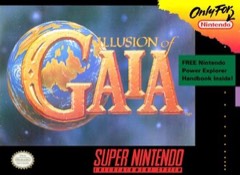
Will is a boy who survived an expedition to the Tower of Babel and can't remember how. In pockets of the world called Dark Spaces, a being named Gaia lets him save his game and, as the story moves on, change form: into Freedan, a tall dark knight with a sword, and later into Shadow, a being of pure energy. Will himself fights with a flute. Illusion of Gaia is a top-down action adventure in which you switch between these forms to reach places and fight what the others can't.
It drops most role-playing trappings. There are no experience points, no shops and no equipment. Clear every enemy in a room and you get a permanent boost to attack, defence or health, once only. Healing herbs are rare. The journey runs in a line through ruins drawn from our world: Incan ruins, the Nazca Lines, Angkor Wat, the Great Wall of China and the Egyptian pyramids, each holding a piece of the puzzle.
Where it sits in history
Quintet developed it, the studio behind ActRaiser and Soul Blazer. Enix published it in Japan on 27 November 1993, and Nintendo published it in North America on 26 September 1994 and in PAL regions, retitled Illusion of Time, in 1995. Yasuhiro Kawasaki wrote the music, manga artist Moto Hagio designed the characters and novelist Mariko Ōhara worked on the story.
Nintendo of America softened the story for release. A tribe near Angkor Wat was originally shown as cannibals, and Will's school was a church run by a priest; both were changed. Fans often group it with Soul Blazer and Terranigma as a loose trilogy, though Enix USA's producer said it had no story connection to Soul Blazer.
How it plays today
Its atmosphere is the strongest thing about it. The story is melancholy and strange for a 1993 console game, with a comet that threatens the world and an ending that asks what its heroes will remember. The ruins give each chapter a distinct look and mood. Switching between Will and Freedan to solve a room is simple but satisfying, and the score is lovely.
The structure works against you. Most areas lock behind you once finished, so any Red Jewels you missed are gone, and the only side quest can become impossible without warning. Combat is basic, the puzzles often come down to hunting for one switch, and the linear path gives little freedom. Go in expecting a story more than a system.
Compared with
- Soul Blazer: Quintet's previous SNES game is more about rebuilding a world and fighting; Illusion of Gaia leans on story and ruins.
- Terranigma: The follow-up in spirit, bigger in scope, with shops, equipment and a freer world.
- The Legend of Zelda: A Link to the Past: Same overhead view, but A Link to the Past lets you roam; Illusion of Gaia marches you forward.
Why it matters
Will fights with a flute. It's a small detail that says a lot about Illusion of Gaia, a game that walks you through Incan ruins, the Nazca Lines, Angkor Wat, the Great Wall and the pyramids, and keeps asking what people leave behind.
Johan Huizinga argued that play is older than culture. Illusion of Gaia makes a lovely, strange fit with that idea. Every monument you visit is something a civilisation built and left, and you explore them through play, the older thing. A boy with a musical instrument wanders among the stones like the first person who ever turned a ruin into a game. The ending asks what its heroes will remember. For most of us, the honest answer is not the monuments. We remember the play: the dark rooms, the nerve it took to clear one, the melancholy tune. Empires rise and crumble into level design. People go on playing in the ruins, as people always have.
Read: Older than us: play before people →
- Huizinga, J. (1938/1949). Homo Ludens: A Study of the Play-Element in Culture.
What you're levelling up
You have been training these without noticing. Here is how to do it on purpose, and where it pays off away from the couch. All the skills games teach →
Problem solving
In the game. Will can become Freedan, a dark knight with a sword, and later Shadow, a being of pure energy, to reach places and fight what the others can't.
Do it on purpose. When a room stumps you, ask which form it was built for before you hunt for the switch. Say out loud why the other forms can't do it.
Off the couch. Some problems need a different version of you: the patient one, the blunt one, the one who asks for help. Pick the right one for the room.
Curiosity
In the game. The journey runs through Incan ruins, the Nazca Lines, Angkor Wat, the Great Wall and the pyramids. Areas lock behind you, so a Red Jewel you missed is gone.
Do it on purpose. Before you leave each area, check every corner and count your Red Jewels. Make it a rule: nothing left behind.
Off the couch. Ask your date where they'd go if they could go anywhere, then actually want to know why. Someone who's curious about the world is good company, even just across the table.
Story sense
In the game. A comet threatens the world, Will can't remember how he survived the Tower of Babel, and the ending asks what its heroes will remember. Strange and melancholy for a 1993 console game.
Do it on purpose. Read every line, no mashing. After the credits, tell someone the story in two minutes, and what you reckon the ending means.
Off the couch. Telling your mates what a film or a book meant to you, not just what happened, makes for the best conversations.
Verdict · 7/10
A moody, memorable adventure with a real sense of place, held back by thin combat and missable collectables. Worth playing for the journey rather than the fighting.