What it was
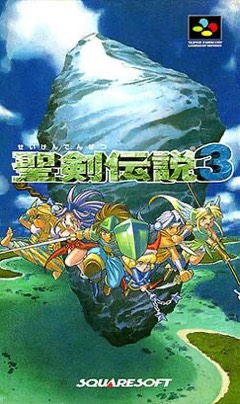
You pick three heroes from six before you start, and that choice decides the game. Your first pick sets which of three storylines you follow and which villains you face; the other two join along the way; the unchosen three turn up as strangers. There is a mercenary out for revenge, a princess with no gift for magic, a half-beast prince who turns into a wolf at night, a young half-elf cleric, a thief framed for murder, and a princess whose brother has been kidnapped.
It plays as a real-time action RPG seen from above, with the two heroes you are not steering run by the computer or a second player. Spin open the Ring Command menu to cast spells or use items and the action pauses. At level 18, and again at 38, each hero chooses a Light or Dark class, which changes their skills. A fast in-game calendar changes day to night and shifts which element is strongest, and some shops and enemies only appear at certain hours.
Where it sits in history
Square released it in Japan on 30 September 1995 as the sequel to Secret of Mana. Series creator Koichi Ishii designed it, Hiromichi Tanaka directed, Nobuteru Yūki drew the characters and Hiroki Kikuta composed the music. The team rebuilt everything from scratch and filled the cartridge, while fighting other projects, Chrono Trigger among them, for programmers.
It never came out in the West on the Super Famicom. Reasons given over the years include bugs, cost and the rise of the PlayStation and Saturn, and a series producer later said the cartridge had no room left for translated text. English-speaking players relied on a 1999 fan translation until 2019, when Square Enix finally released it officially as Trials of Mana in Collection of Mana on Switch. A full 3D remake followed in 2020.
How it plays today
It is one of the best-looking games on the console, full of soft colour and detail, and Kikuta's score is warm and inventive. The branching start gives it real replay value: six characters, three plots and a split class tree mean a second run can feel quite different from the first. Two-player co-op is a treat.
The combat is where it frays. Fights can become a scrum of flashing numbers, the computer allies have little sense of tactics, and you cannot open the menu while your hero is mid-action, which makes boss fights hectic. The stories themselves lean on familiar fantasy material, and characters outside your chosen trio get little explanation. None of that stops it being a lovely game to spend time in.
Compared with
- Secret of Mana: The predecessor, with three-player co-op; Seiken Densetsu 3 cuts that to two but adds six heroes and a class system.
- Chrono Trigger: Square's other big 1995 release, which pulled programmers from this team; tighter storytelling, less freedom in building your party.
- Star Ocean: Another late Super Famicom action RPG that never left Japan on cartridge, with real-time combat and plenty of branching.
Why it matters
Seiken Densetsu 3 asks who you are before it tells you anything. Three heroes from six: a mercenary out for revenge, a thief framed for murder, a half-beast prince who turns into a wolf at night, a princess with no gift for magic. Your first pick decides which villains you meet. Later, at levels 18 and 38, each hero chooses Light or Dark. It is a game about becoming, and it lets you steer.
Andrew Przybylski and colleagues found games are most engaging when playing a character brings people closer to their ideal self. The princess with no gift for magic is a neat test of that. Pick her and the game becomes about growing into something you were told you were not. Whichever trio you choose, the class tree keeps asking which version of them you want, and so which version of you. The three you leave behind turn up as strangers, a small reminder that every choice closes a door.
Read: Who you are when you play →
- Przybylski, A. K., Weinstein, N., Murayama, K., Lynch, M. F., & Ryan, R. M. (2012). The ideal self at play: The appeal of video games that let you be all you can be. Psychological Science, 23(1), 69-76. doi:10.1177/0956797611418676
What you're levelling up
You have been training these without noticing. Here is how to do it on purpose, and where it pays off away from the couch. All the skills games teach →
Planning ahead
In the game. You pick three heroes from six before you start, and your first pick decides the storyline and villains. Then at level 18 and 38 each one picks Light or Dark.
Do it on purpose. Before a class change, write down what your party is missing and choose to fill that gap, not what looks coolest.
Off the couch. Picking a course or a job for what it builds in you, not just how it sounds. Future you will thank you.
Story sense
In the game. Six characters, three plots, and the three you didn't pick turn up as strangers. Seeing someone as a hero one run and a stranger the next is the whole trick.
Do it on purpose. On a second run, pick the trio you ignored. Notice how differently the same world feels from their side.
Off the couch. Everyone's the main character of their own story. Getting that makes you the person people actually want to talk to, on a date or anywhere.
Curiosity
In the game. A fast in-game calendar shifts day to night, and some shops and enemies only appear at certain hours. You only find them if you go looking.
Do it on purpose. Revisit a town at night and note what's different. Keep a list of what only shows up after dark.
Off the couch. Going back to the same place at a different time, the beach at dawn, the pub on a Tuesday, shows you a whole other side. Good first date material too.
Verdict · 8/10
A beautiful, generous action RPG with messy combat and a story built for replaying. Worth playing now it is easy to get in English.