What it was
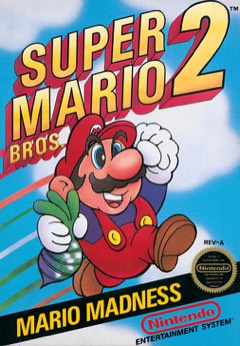
Mario dreams of a staircase, a door and a voice asking for help against a tyrant frog called Wart. Next day, on a picnic, he, Luigi, Toad and Princess Toadstool find that staircase in a cave, climb it, and step into the dream world of Subcon. That alone tells you this is not the Mario of 1985.
Before each stage you pick a hero, and they really do play differently. Luigi jumps highest with a scuttling kick of the legs, the Princess floats, Toad is fastest and strongest but jumps lowest, and Mario sits in the middle. Jumping on enemies does nothing. Instead you stand on them, lift them, and throw them, along with vegetables pulled from the dirt and mushroom blocks. The screen scrolls both ways and up and down. A magic potion opens a door into Sub-space, a mirrored room where coins and extra health hide, and the right jar in Sub-space warps you worlds ahead. Twenty levels across seven worlds end at Wart.
Where it sits in history
Japan already had a Super Mario Bros. 2, released in 1986: the first game made far harder. Nintendo of America judged it too similar and too punishing for a market still recovering from the 1983 crash, and asked for something friendlier. The answer came from Kensuke Tanabe, whose vertical-scrolling, lift-and-throw prototype had been shelved and then reborn as Yume Kōjō: Doki Doki Panic, a 1987 Famicom Disk System game starring the mascots of a Fuji Television expo.
Minoru Arakawa asked for that game to become Mario's sequel. The team, Nintendo R&D4, drew Mario, Luigi, the Princess and Toad over the four Doki Doki Panic heroes, gave Luigi his height, added running on the B button, and dropped the rule that every level be cleared with every character. It reached North America on 9 October 1988 and Europe and Australia on 28 April 1989, topped the US sales charts for fourteen months straight, and sold 7.46 million copies. Japan finally got it in 1992, as Super Mario USA.
How it plays today
It holds up because it is so odd. Throwing a Shy Guy at another Shy Guy is satisfying in a way stomping never quite is, and choosing a hero per stage turns every level into a small question: do I want Luigi's height here, or the Princess's float? The music is Koji Kondo, and Wart's theme is a highlight.
Some of it is slow. Pulling turnips over and over gets old, a few bosses repeat, and Toad's short jump makes him a niche pick. But it has more variety than the first game, and its ideas did not stay odd for long: Birdo, Shy Guys, Bob-ombs and Pokeys all moved into the wider Mario world, and Super Mario 3D World brought back the same four heroes with the same strengths.
Compared with
- Super Mario Bros. 2: The Japanese sequel the West passed on: the first game again, much harder.
- Super Mario Bros. 3: Mario's next NES game, back to stomping and on a grander scale.
- Super Mario All-Stars: The Super NES remake, with new graphics, five starting lives and a character switch after every death.
Why it matters
Four heroes, same levels, and each one changes how the level feels. Players pick the Princess because she floats, and then keep picking her because she is theirs. Gee calls this a projective identity: not quite you and not quite the character, but a blend shaped by what you want that character to be.
That is why friends still argue about it. Ask who someone played in Super Mario Bros. 2 and you learn a little about how they like to move through a hard thing: carefully, quickly, or floating over the top.
Read: Who you are when you play →
- Gee, J. P. (2003). What Video Games Have to Teach Us About Learning and Literacy.
What you're levelling up
You have been training these without noticing. Here is how to do it on purpose, and where it pays off away from the couch. All the skills games teach →
Problem solving
In the game. Before each stage you pick a hero, and the stage is a small question: Luigi's height or the Princess's float?
Do it on purpose. Replay a stage with each of the four heroes. Note which one made it easiest and why.
Off the couch. Picking the right tool, or the right person, for the job saves heaps of time at work and around the house.
Curiosity
In the game. A magic potion opens a door into Sub-space, where coins and extra health hide, and the right jar warps you worlds ahead.
Do it on purpose. Drop a potion in every new area you reach. Note what each Sub-space holds.
Off the couch. Trying the odd door, a new class or a weird restaurant, gives you more to talk about. Good for any date.
Story sense
In the game. It's all a dream: a staircase, a voice asking for help, a frog called Wart. Who you pick says a bit about how you play.
Do it on purpose. Play through with each hero and decide which one is most like you. Then play as the one least like you.
Off the couch. Seeing things from another angle, a mate's or a partner's, makes you better company and better at sorting out arguments.
Verdict · 8/10
The black sheep that turned out to be one of the family's best ideas. Play it with all four heroes and see who you are.