What it was
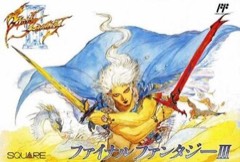
Final Fantasy III is where the series learned to change clothes. Four orphans from the village of Ur fall into a cave after an earthquake, meet a dying Wind Crystal and set off as Warriors of Light. They start as plain Onion Knights, but each crystal hands out new jobs, and you can switch any character to any unlocked job between battles: Warrior, Monk, White Mage, Black Mage, Dragoon, Ninja, Summoner and more.
Each job does one thing its own way. Dragoons leap out of the fight and crash down on a target, Ninjas steal, Summoners call monsters for heavy damage. The job also sets what a character can equip and how they grow. Around that sits a classic turn-based role-playing game: a floating continent to start, then a flooded world below, reached on foot, by chocobo, by ship and finally by airship.
Where it sits in history
Square released it on the Famicom on 27 April 1990, the last Final Fantasy made for that console and one of its largest games, on a 512 KB cartridge. Hironobu Sakaguchi directed, with Hiromichi Tanaka and Kazuhiko Aoki designing and Nobuo Uematsu composing. It was Nasir Gebelli's last original Final Fantasy; when his visa expired mid-project, the team followed him to Sacramento and finished the game there.
After Final Fantasy II's unusual growth system confused players, the team went back to experience levels and pinned the fun on jobs instead, an idea from Sakaguchi. Summons and Moogles, first planned for the second game, arrived here. It sold 1.4 million in Japan, more than the first two games there. A planned English release was dropped so the team could focus on the Super Famicom, and the original did not officially leave Japan until the Pixel Remaster in 2021.
How it plays today
The job system still gives it life. Trying a new line-up for a tough boss, or finding the one job that trivialises a dungeon, is the same pleasure later Final Fantasy games built on. The music is some of Uematsu's best on the Famicom, and the world opens up in satisfying steps.
Its difficulty is uneven and at times harsh. The final stretch has no save points at all; Sakaguchi reportedly took them out after a tester called it too easy, and reviewers at the time complained about the lack of dungeon saves too. The story is a string of events rather than characters, and one early reviewer found it moved too fast to follow. A modern version eases most of that.
Compared with
- Final Fantasy: The first game fixes your classes at the start; III lets you change them whenever you like.
- Final Fantasy II: The sequel's grow-by-use system is gone, replaced with levels and jobs that are much easier to understand.
- Final Fantasy V: The SNES game takes III's job system and deepens it, letting characters carry skills between jobs.
- Dragon Warrior IV: The same year's rival Famicom epic, stronger on story, less flexible in how you build your party.
Why it matters
Final Fantasy III is where the series learned to change clothes. Four orphans start as Onion Knights and, crystal by crystal, can become Dragoons, Ninjas, Summoners, anything unlocked, swapped between fights. The same kid heals in one dungeon and steals in the next.
Nick Yee and Jeremy Bailenson found people's behaviour shifts to match the avatar they are given, which they called the Proteus effect. They studied avatars, not job menus, but the pull feels familiar here: put a character in a Dragoon's armour and the urge to leap into every fight follows. James Paul Gee's projective identity, a blend of the real self and the character shaped by what the player wants it to be, explains the pleasure. The jobs are costumes, and choosing them is a small act of self-authorship. Trying a new line-up for a tough boss is really trying on another way of being. The game quietly argues identity is less fixed than we think, and we all like finding out who else we could be.
Read: Who you are when you play →
- Yee, N., & Bailenson, J. (2007). The Proteus effect: The effect of transformed self-representation on behavior. Human Communication Research, 33(3), 271-290. doi:10.1111/j.1468-2958.2007.00299.x
- Gee, J. P. (2003). What Video Games Have to Teach Us About Learning and Literacy.
What you're levelling up
You have been training these without noticing. Here is how to do it on purpose, and where it pays off away from the couch. All the skills games teach →
Problem solving
In the game. Any character can switch to any unlocked job between fights: Dragoons leap, Ninjas steal, Summoners call monsters. Finding the one job that makes a dungeon easy is the whole fun.
Do it on purpose. When a boss beats you, change one job only and go again. Write down which change made the difference.
Off the couch. Stuck at work? Change one thing at a time and you'll know what fixed it. Change everything at once and you've learnt nothing.
Judging risk
In the game. The final stretch has no save points at all. Push on low on items and one bad fight can wipe hours.
Do it on purpose. Before the last stretch, set a rule for what you need stocked. Don't take a step further until you've got it.
Off the couch. Quitting a job, signing a lease, a big trip. Know what you need in the bank before you jump, and the jump stops being scary.
Curiosity
In the game. Four orphans start as plain Onion Knights, and each crystal unlocks new jobs. The world grows from a floating continent to a flooded world below, by foot, chocobo, ship and airship.
Do it on purpose. Each time new jobs unlock, put every character in one they've never tried for a full dungeon. See who surprises you.
Off the couch. Trying new stuff, a cooking class, a new sport, makes you better company. You've got more to talk about, and you're keen to hear what they've been trying too.
Verdict · 7/10
The game that gave Final Fantasy its job system, and still fun to tinker with. The Famicom original is harsh by modern standards; the Pixel Remaster keeps the design and drops much of the pain.